Playwright MCP and Regression Testing: Create with the Agent, Replay Without an LLM
Playwright MCP lets an AI agent test your site. For regression testing, the agent creates the scenario and Delta-QA replays it identically.
Read more →7 articles
Artificial intelligence has aggressively entered the discourse of visual testing tools: "Visual AI", "self-healing tests", "smart diff" — every vendor claims its own AI layer. Behind the marketing terms, the technical reality is more nuanced — most often it boils down to perceptual algorithms (SSIM, embeddings) trained to filter cosmetic noise so that only likely meaningful differences surface. That is useful, sometimes remarkable, but it is not magic: a false negative in a visual test is still a bug shipped to production.
This page gathers articles that examine AI in testing with a critical eye: what the Visual AI promises of major vendors (Applitools first and foremost) actually cover, where the contribution is tangible and where it leans more toward marketing, how to evaluate the reliability of a so-called intelligent algorithm without falling into the black-box trap, what precautions to take when a tool decides on its own whether a difference is "important". We also cover the rising topic of LLMs applied to testing — scenario generation, automatic diff classification, review assistance — distinguishing promising uses from empty announcements. Delta-QA does not use generative AI in its current comparison engine, and these articles take a deliberate stance of honesty about what AI really brings to visual testing today.
Playwright MCP lets an AI agent test your site. For regression testing, the agent creates the scenario and Delta-QA replays it identically.
Read more →
Meticulous.ai (AI-driven traffic replay) vs Delta-QA (deterministic regression testing, no learned model). Two radically different philosophies compared.
Read more →
How screenshot comparison really works: capture, the alignment step most guides skip, then pixel vs SSIM vs pHash comparison, explained step by step.
Read more →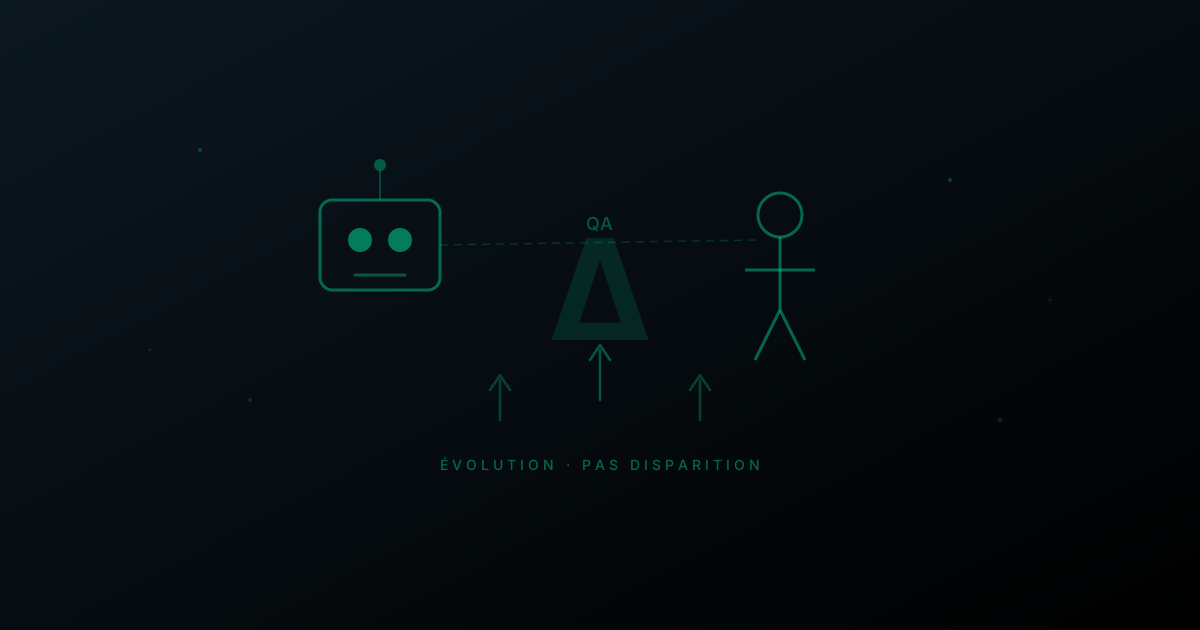
Will AI replace QA engineers? A historical analysis and a vision of the testing profession in a world dominated by artificial intelligence and automation.
Read more →
A forward-looking analysis of the visual testing market. No-code, determinism, data sovereignty, native CI/CD: here's what will change in 2027.
Read more →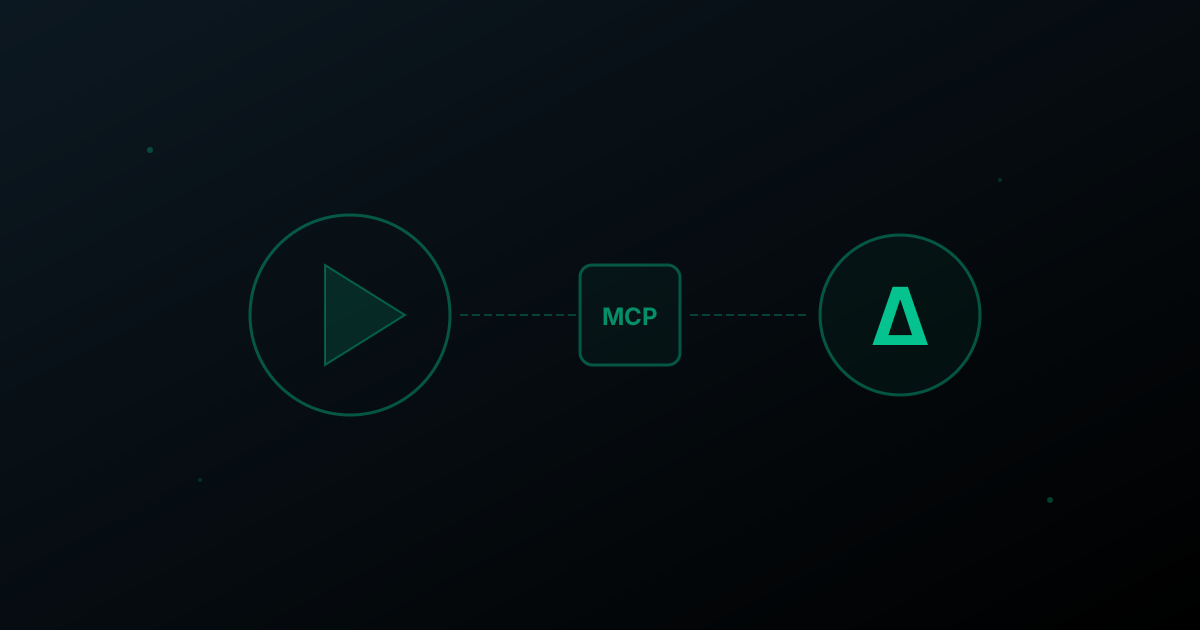
Model Context Protocol (MCP) integrates Playwright into AI. What changes in 2026? Why deterministic visual tests remain indispensable.
Read more →
How visual testing tools detect differences: pixel, perceptual and structural comparison. How each approach works, its strengths and its limitations.
Read more →